
Eucalyptus scoparia

Origin of the species name
Eucalyptus from Latin meaning well-covered and describes the cap on the flower bud; scoparia is derived from a Latin word meaning broom-like.
Family
Myrtaceae
Date planted
March 2010
Lifespan
Trees of this species are expected to live over 50 years.
General description
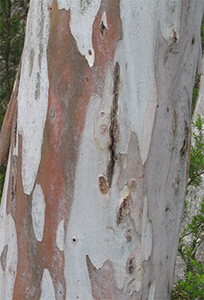
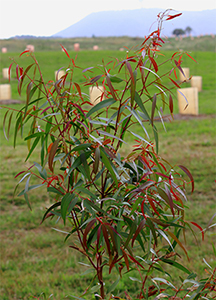
This is typically a small to medium-sized evergreen tree but has grown larger in cultivation and can develop a large, dense crown. It has smooth, powdery white to pale grey bark and shiny green adult leaves. Height 20m Spread 12m.
Natural distribution and habitat
The species is native to a very restricted area along the borders between southern Queensland and northern New South Wales, Australia where it grows as scattered trees on bare slopes and the tops of mountains, mainly in depressions among granite outcrops, where the soil can be very limited.
Conservation status
It is a threatened species with the main threat being the clearing and fragmentation of open forest and woodland habitat for agriculture and development. As populations are small, the risk of local extinction exists. Measures are being taken to protect the species within its natural range.
Planting pattern
The planting lines approximate the contour lines.
Uses
It is widely used in parks, gardens and as a street tree. The wood is pale coloured and tends to split.
Further reading
Boland DJ, MIH Brooker, GM Chippendale, N Hall, BPM Hyland, RD Johnston, DA Kleinig, MW McDonald and JD Turner (2006) Forest Trees of Australia (5th Edition) CSIRO Publishing.