
Platycladus orientalis
Other common names
Chinese thuja, Oriental arborvitae. Chinese: Ce bai
Origin of the species name
Platycladus from Greek meaning broad or flat branch; orientalis from Latin referring to it being from the east, in this case from east Asia.
Family
Cupressaceae
Date planted
April 2010
Lifespan
Some cultivated trees of this species in China are thought to be over 1000 years old.
General description
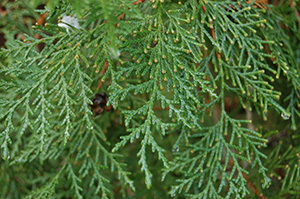
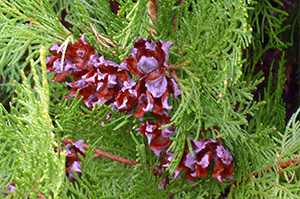
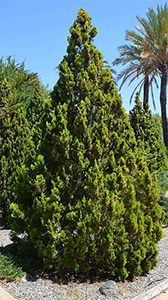
This is a slow-growing small to medium-sized, densely-branched evergreen tree. The bark on the trunk and large branches becomes fibrous and can peel off in long strips. The numerous, slender, ascending branches support shoots that spread out in flat, vertical planes. The small cones are a waxy blue-green before maturing to brown. Height 18m Spread 6m.
Natural distribution and habitat
The species is native to northwestern China, Korea and the Russian Far East. It is apparently quite widespread but the range is confused by populations which may have been planted. It occurs in cold dry regions including both open woodland and open and often unstable slopes from 300 to 3,300 m in China.
Conservation status
It is classified as being a rare, near threatened species and is the only species of its genus. As it has been in cultivation for a long period, considerable confusion exists in terms of what are natural stands and what are planted stands of the species.
Planted pattern
Planted in straight lines forming a check pattern.
Uses
The common name 'arborvitae' is from Latin meaning 'tree of life', and is based on its association with long life and vitality in Buddhist thought in China. The wood is used in Buddhist temples, both for construction work and chipping for incense burning. The foliage is also used for incense.
Further reading
Farjon, A (2010) A Handbook of the World's Conifers. Brill.