
2 tree species planted in Forest 60:
Pinus radiata and Pinus halepensis
Pinus radiata variety radiata Radiata Pine
Other common names
Monterey Pine.
Origin of the species name
Pinus is classical Latin for pine; radiata is Latin and is thought to refer to the radial markings on the scales of the cone.
Family
Pinaceae
Date planted
2004
Lifespan
Trees of this species have an average lifespan of 80-90 years.
General description
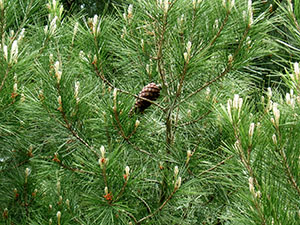
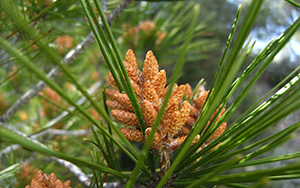
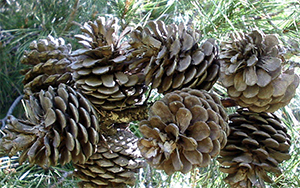
This is a medium-sized conifer with a single trunk which, in the wild, is often forked or branched near the ground. The bark is often deeply fissured and is rough and scaly. The branches are spreading or ascending to form a dense crown. The leaves are needle shaped, usually in groups of three. Pollen cones are orange-brown, cylindrical and held in clusters. Seed cones take two years to mature. They are shiny brown, egg-shaped and often in dense groups. They are strongly asymmetrical. This species has a long history on the Arboretum site and was grown here for many decades, prior to the bushfires of 2003. Regardless of their shape, all the large trees growing on Dairy Farmers Hill are Pinus radiata. Height 25m Spread 18m.
Natural distribution and habitat
This variety occurs naturally on the south west coast of the USA. It grows on rocky coast lines from the sea level up to 400m where it forms pure stands or grows amongst other conifers or deciduous species.
Conservation status
Despite the wide planting of radiata pine around the world it is a threatened species in its natural habitat with 50% of the P. radiata var. radiata forest felled since Europeans arrived in California. The removal of natural fire succession and the introduction of disease are major threats.
Planting pattern
The radiata pines on Dairy Farmers Hill are a few lucky survivors of the 2003 bushfires.
Uses
Radiata pine is the most widely planted tree species in the world. The wood is has been used for pulp, construction, carpentry, veneers, furniture, laminated wood, crates and boxes. The bark is often used as garden mulch. The tree has been widely planted in parks and as windbreaks.
Further reading
Farjon, A (2010) A Handbook of the World's Conifers. Brill.
Pinus halepensis Aleppo Pine
Other common names
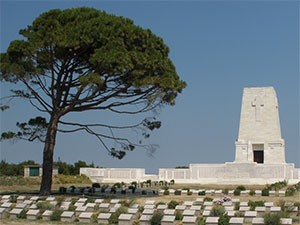
Lone pine. Spanish: Pino de Alepo. French: Pin d'Alep. Italian: Pino d'Aleppo.
Origin of the species name
Pinus is the classical Latin for pine; halepensis is derived from Aleppo on the coast of Syria and means from that area.
An important tree
A cone of the Aleppo Pine was collected at the site of the ANZAC battle at Lone Pine at Gallipoli by an Australian whose brother had died in the attack there on 6 August 1915. He found the cone after the battle on the branches used by the Turks to cover their trenches. He sent the cone to his mother who in time presented the tree to the Australian War memorial in honour of her son and others who died at Lone Pine. All seven Aleppo pines planted at the Arboretum in Forest 60 were sourced from cones collected from this tree. On September 2008, The Hon. Kevin Rudd MP, Prime Minister of Australia, accompanied by representatives of the Returned and Services League of Australia, planted one of seven Aleppo pines on Dairy Farmers Hill.
Family
Pinaceae
Date planted
September 2008
Lifespan
Trees of this species can attain full height in 50 years.
General description
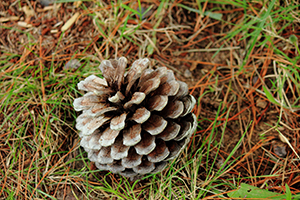
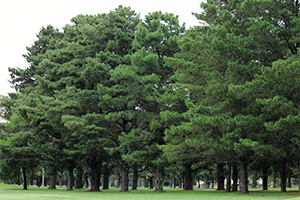
This is a medium-sized, evergreen conifer. It has fissured grey bark which develops reddish-brown scaly plates with age. The needles are 7-10 cm log, slender and a yellowish green. Male and female cones occur on the same tree. The pollen cones are orange-brown and held in clusters. Seed cones are light green when young, maturing to reddish-brown two years later. They grow on short stems pointing downwards and this is one feature that distinguishes them from the similar P. brutia. When ripe, the cones release winged seeds. Height 18m Spread 10m.
Natural distribution and habitat
The species is native to North Africa, the Middle East and Mediterranean Europe. It occurs in some of the more arid and more frequently burnt parts of the Mediterranean region from sea level up to 1700m, often on limestone and dolomite.
Conservation status
Although it is not classified as a threatened species, there are populations in the east Mediterranean, such as the Mt Carmel Nature Reserve, that are being seriously affected by changes in land use and the introduction of other pine species and other Aleppo pine populations. Protection of the old stands and removal of other plantings is necessary to preserve the genetic integrity of the original population of the area.
Planting pattern
Four trees were planted on the upper level and three on the southern side of Dairy Farmers Hill.
Uses
The timber from this species is not of high quality and has mainly been used for mine props, railway sleepers, telegraph poles, firewood and charcoal in Algeria and Morocco. Resin collected from the trees plays an important role in the economies of eastern Mediterranean communities. An average tree can yield 3-4 kg of resin each year. The same communities are also involved in forest honey production.
Further reading
Farjon, A (2010) A Handbook of the World's Conifers. Brill.