
Betula nigra
Other common names
Water Birch
Origin of the species name
Betula is the Latin name for the genus and is derived from the ancient Gaul word for 'pitch' which refers to the bituminous content of the bark; nigra is Latin for black and refers to the dark bark.
Family
Betulaceae
Date planted
August 2010
Lifespan
Trees of this species live for 30 to 40 years, or longer in moist situations.
General description
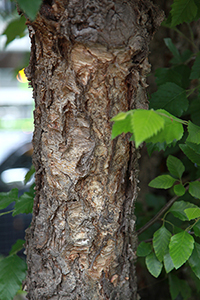
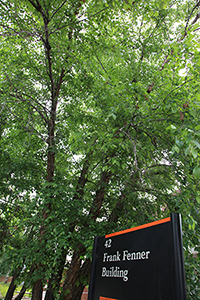
This is a medium sized deciduous tree and the trunk generally divides low into several upright trunks. The bark is usually dark grey and scaly. The flowers are wind pollinated catkins near the end of the twigs. Height 25m Spread 15m.
Natural distribution and habitat
This species is native to the more eastern and southern states of the USA where it grows around swamps and on flood plains and river banks and so is well-suited to areas that are periodically wet.
Conservation status
Although it is not classified as a threatened species, it is a species used for conservation work such as strip mine reclamation and erosion control. It is also used in forested riparian buffers to help reduce stream bank erosion, protect water quality, and enhance aquatic environments.
Planting pattern
A random pattern of straight and curved rows.
Uses
It is used mainly by local businesses for the manufacture of inexpensive furniture, basket hoops and turned articles. The wood is not in high demand because it is usually too contorted and knotty to be of value. Its distinctive peeling bark makes it popular for landscaping. Native Americans used the boiled sap as a sweetener, and the inner bark as a survival food. They also used the tree medicinally to treat dysentery and colds.
Further reading
Palmer, C (2008) Trees and Forests of North America. Abrams.a