
Cercis siliquastrum
Other common names
Judas Tree, European Redbud.
Origin of the species name
Cercis means weaver's shuttle and refers to the shape of the fruit; siliquastrum is derived from the Latin word meaning pod.
Family
Fabaceae
Date planted
August 2008
Lifespan
Mediterranean redbuds can live up to 40 years.
General description
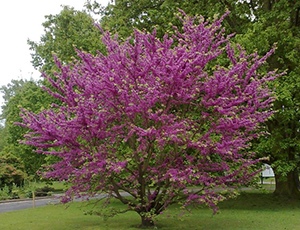
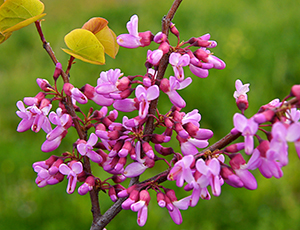
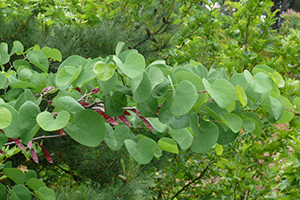
This is a small deciduous tree having a grey bark with numerous fine fissures. The leaves are heart-shaped with a blunt apex and appear shortly after the first flowers emerge. The deep pink flowers are produced on year-old or older growth, including the trunk, in late spring. The tree produces long flat, bright red pods that hang vertically. Height 12m Spread 10m.
Natural distribution and habitat
It is native to the Middle East and southern Europe where it grows in woods on stony arid slopes along the banks of rivers, mainly in calcareous soils.
Conservation status
It is not considered to be a threatened species in the wild.
Planting pattern
Planted in a series of large concentric circles around a rocky outcrop near the Events Terrace. Elsewhere the pattern is random as it flows into a regular square grid at the edges.
Uses
There is a longstanding myth that Judas Iscariot hanged himself from a tree of this species. This belief is related to the common name "Judas tree" which is possibly a corrupted derivation from the French common name, Arbre de Judée meaning 'tree of Judea', referring to a region where the tree occurs. The wood is very hard, has a beautiful grain, and is used for veneers as it polishes well. The flowers have a sweetish-acid taste, and are added to salads. The flower buds themselves are pickled and used as a condiment.