
Parrotia persica
Other common names
Persian Witch Hazel
Origin of the species name
Parrotia refers to F.W. Parrot (1792-1841), a German naturalist and traveller who climbed Mount Ararat in 1834; persica from Latin meaning of or from Persia.
Family
Hamamelidaceae
Date planted
September 2008, autumn 2010 and 2013.
Lifespan
Persian ironwoods can live for 80 years or more.
General description
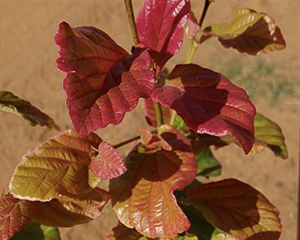
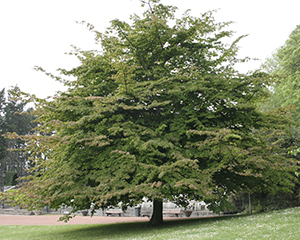
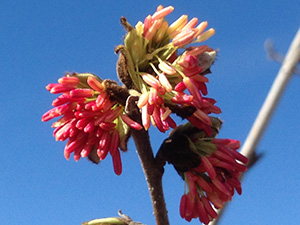
This is a small to medium-sized deciduous tree that is often low-branched and multi-stemmed. It has an attractive, pinkish-brown to a grey-brown bark which flakes off in large, flat pieces. Its leaves turn from dark green in summer to a mix of brilliant yellow, orange and red in autumn. The male flowers do not have petals but instead showy red stamens and the female flowers numerous small scales. Height 15m Spread 10m.
Natural distribution and habitat
The species is endemic to northern Iran where it occurs mostly in moist deciduous forest in sometimes alkaline soils on low lying plains and mountain foothills where it forms either pure stands or is scattered within other deciduous forests.
Conservation status
Although it is not currently regarded as a threatened species it is possibly one of only two widely separated species in the genus Parrotia. It is also an important species in protecting slopes with grades of up to 60%, from landslides in northern Iran.
Uses
The name 'ironwood' comes from the almost indestructible nature of the tree's timber which may explain why it is not commercially grown. Herbalists have used the species for the treatment of various fevers and respiratory infections. It is also used for food colouring and food flavouring. It was first collected by the German naturalist, F.W. Parrot, on Mt Ararat while he was searching for Noah's Ark.
Planting pattern
Planted in long, equally spaced rows following the curve of Forest Drive.
Further reading
http://www.pacifichorticulture.org/articles/striving-for-diversity-persian-ironwood/